Table of contents
Chronic stress is no longer a niche concern, it is a daily condition shaping work, sleep and relationships, and public health agencies keep warning that sustained stress raises risks for anxiety and depression, cardiovascular disease and immune dysfunction. Yet one driver often hides in plain sight: the home itself. From glare and noise to cluttered paths and the inability to “switch off”, layout can quietly keep the body on alert. The good news is that design choices are measurable, actionable and, for many households, cheaper than they look.
When rooms keep your body on alert
Can a hallway raise your heart rate? It can, if it turns every evening into a sequence of tiny frictions, and chronic stress is built exactly that way, not only through major life events but through repeated, low-grade triggers that tell the nervous system it is never fully safe. In 2023, the World Health Organization described stress as a “major public health challenge”, and the American Psychological Association has repeatedly documented high levels of reported stress in the population, with spillover into sleep, concentration and physical symptoms. Home is supposed to be the counterweight, and yet it can amplify the problem through light, sound, temperature, crowding and the constant visual reminders of unfinished tasks.
Start with sensory load, because the brain reads it as risk. Excessive noise is a well-established stressor, and large studies link long-term environmental noise exposure to sleep disturbance and cardiovascular outcomes; at the household level, thin walls, hard surfaces and a TV audible from every room can make “rest” physiologically impossible. Then there is light, and not just brightness. Harvard Medical School’s sleep researchers have long warned that evening exposure to blue-rich light suppresses melatonin, shifting circadian rhythms; a layout that funnels you past bright kitchen downlights and large screens right before bed does not help. Add temperature instability, poorly placed vents and a bedroom that never cools properly, and you have conditions that keep cortisol rhythms from settling. None of this is abstract: it shows up as a shorter fuse, a racing mind at night and a morning that begins already tense.
Finally, look at movement patterns, because they shape emotion. A cramped entry where bags, shoes and coats collide creates micro-conflict before you even greet anyone, while a living room arranged as a thoroughfare forces constant negotiation of space, and humans interpret repeated spatial negotiation as social tension. Environmental psychologists have long noted the role of “privacy regulation”, the ability to control interaction and retreat; in homes where bedrooms open directly onto noisy communal zones, or where there is no buffer between work and family life, the opportunity to downshift shrinks. The result is a home that functions, technically, yet feels like a workplace with a sofa.
The stress hotspots designers see first
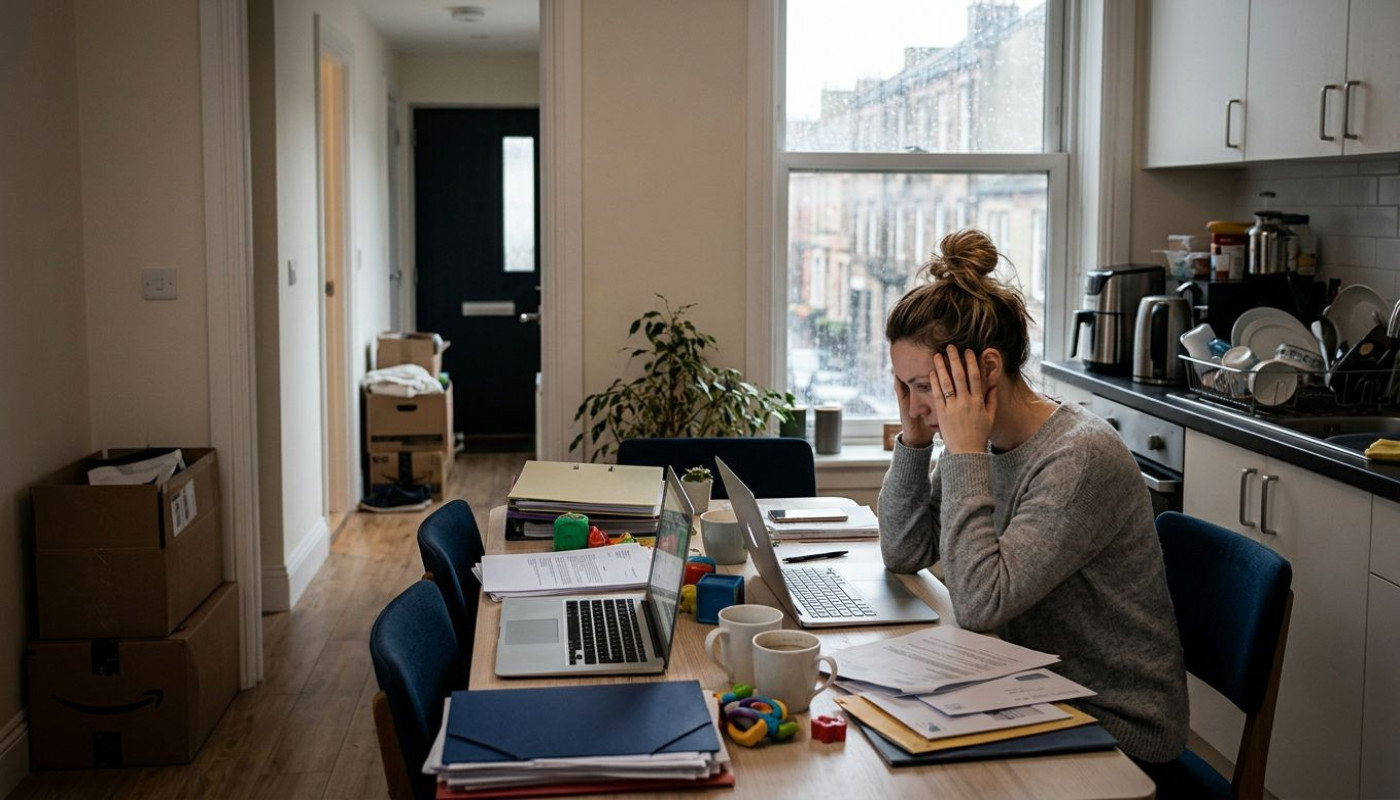
The biggest red flag is obvious, and it is not aesthetic: sightlines packed with chores. When the kitchen is visible from the couch, and the laundry piles sit in the corridor, the brain keeps tagging tasks as incomplete, and that persistent “open loop” feeling is a known contributor to mental load. It is the same mechanism that makes unfinished work hard to forget, and at home it can turn relaxation into a guilty pause. The issue is not mess as a moral failing, it is the constant visual cueing of responsibility, and layouts that leave no place to hide functional clutter make that cueing relentless.
Noise and interruptions come next, and the pandemic work-from-home shift made the pattern easier to spot. Many households turned corners of living rooms into offices, but acoustics did not magically adapt, and the lack of a physical boundary means every conversation feels like an interruption, while every email feels like it invades family space. Research on open-plan offices has repeatedly shown higher distraction and reduced perceived privacy compared with enclosed spaces; homes that replicate open-plan conditions can reproduce the same stress signature. Add to that the “multi-use room trap”, where a dining table is breakfast, homework, spreadsheets and bills, and you end up with no psychological reset, because the environment never signals that one role ended and another began.
Bedrooms are a particular hotspot because sleep is stress’s pressure valve, and layout often undermines it. A bedroom that doubles as storage, exercise space or office, or one that forces you to face a desk and a charging station, can make the room feel like a to-do list. Sleep medicine guidance from the American Academy of Sleep Medicine and other bodies emphasizes stimulus control, associating the bedroom with sleep rather than wakeful activity; spatial cues matter. Even small choices count: mirrors reflecting light, a bed aligned with a bright doorway, or a closet light that floods the room each time someone grabs a sweater. If you wake up already braced for the day, your layout may be training that response.
Small changes with outsized effects
Rebuilding walls is not the point, and the most effective fixes often begin with traffic flow. Map the routes people take in the morning and evening, then remove bottlenecks. A clear landing zone near the entrance, with hooks, a bench or a basket system, reduces the “where is my stuff?” spiral that kicks off stress at the worst possible time. In living areas, keep walkways wide and direct, because constant sidestepping is low-level irritation, and low-level irritation is how chronic stress becomes normal. If your sofa sits in a passage, rotate the layout so the seating area becomes a destination, not a corridor.
Next comes light, and the goal is to give your nervous system a timetable. Use brighter, cooler light earlier in the day, and warmer, lower light in the evening, and if overhead fixtures feel harsh, layer lighting with lamps that keep brightness below eye level. Blackout curtains in bedrooms can be transformative, especially in cities with street lighting, and a rule of “no bright task lighting after dinner” can align with circadian science more than most wellness gadgets. Sound follows the same logic: rugs, curtains and bookshelves absorb more than people think, and a door that closes fully is an intervention, not a luxury. If you cannot add a door, a heavy curtain and a white-noise machine can still create a sensory boundary.
Clutter is where many plans fail, so treat it like infrastructure. Closed storage in the line of sight from resting areas matters more than perfectly labelled bins, and the fastest win is to move high-visual clutter out of the primary relaxation view. If the living room must face the kitchen, hide dishes, wipe counters and store tools quickly, because visual calm is cumulative. For households trying to track symptoms, triggers and routines alongside changes at home, structured documentation can also help clarify what is working, and click here to investigate a SOAP note template approach that some people use to organize observations consistently. The point is not to medicalize your living room, it is to make patterns visible, because stress feels amorphous until you measure it.
Renters and families are not stuck
Do you have to own your home to change it? Not at all, and renters often have the strongest incentive to focus on reversible, high-impact steps. Start with the bedroom, because sleep improvement pays back quickly. Move the bed away from the brightest wall, block streetlight with temporary blackout solutions, reduce charging clutter at the bedside, and keep the work bag out of view. If you work from home in a shared space, create a visual “office mode” that appears and disappears, such as a folding screen, a rolling cart for equipment and a rule that the laptop is packed away at a set time. When the environment stops broadcasting work, the mind follows more easily.
For families, the key is to design for predictable routines, and that includes children’s needs for autonomy and adults’ need for quiet. A homework zone that is close enough for supervision yet not in the center of the living room can reduce conflict, because it lowers interruptions for everyone. If you have an open-plan space, use furniture to carve out territories: a bookcase can act as a soft wall, and an area rug can signal where play ends and calm begins. Noise is often the hidden accelerant in family stress, so consider door draft stoppers, felt pads under chairs, and soft materials in the loudest rooms. These are small expenses, but they change the acoustic character of a home, and the body responds to acoustics faster than it responds to intentions.
Finally, treat “alone time” as a layout problem, not a personal failure. Many households have no room dedicated to decompression, and the result is people trying to rest in the middle of activity, then feeling irritated when it does not work. A corner chair with a lamp, a plant and a small table can become a decompression station, especially if it faces away from the busiest sightlines. In tight apartments, even a balcony, a window seat or a section of the bedroom can be designated as the low-stimulus zone. The principle is consistent with what psychologists call boundary management: when boundaries are clear, self-control costs less, and stress drops because fewer decisions are required.
Planning the next step, without overspending
Before buying anything, walk through your home at the times you feel most tense, note the three most repetitive irritations, then fix those first. Many changes cost under a few hundred dollars, and some are free, especially decluttering sightlines and redefining zones. If you are considering larger work, book one consultation, set a firm budget and ask about local energy-efficiency or insulation incentives, because quieter, better-sealed rooms often feel calmer fast.
On the same subject

